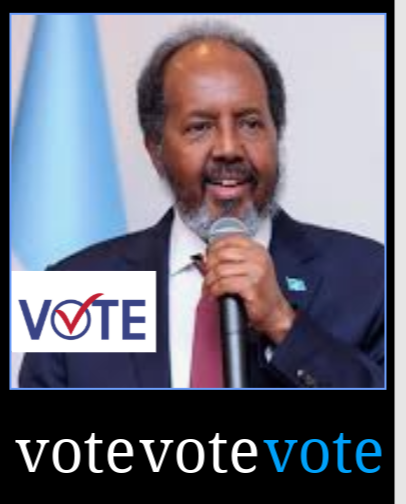



Almost all Somalis are deeply alarmed by President Hassan Sheikh Mohamud’s insistence on proceeding with an isolated, legally defective, and widely rejected “local election” in Mogadishu. The central question is unavoidable: why is the president spending millions of dollars on a party-driven electoral exercise that directly violates the March 2024 constitutional amendments and the 2024 electoral legal framework, while the country faces acute political, economic, and security crises?
This is neither a technical nor a routine political dispute.
It is a fundamental question concerning a breach of Somalia’s constitutional order.
1. An Election with No Constitutional Basis
Under the March 2024 amendments to the Provisional Federal Constitution, together with the Electoral Law, the Electoral Commission Law, and the Political Parties Law passed in 2024, local elections were never designed to be selectively, arbitrarily, or capriciously implemented, nor limited to Mogadishu, nor used as instruments to foment political conflict.
Legally, local elections were intended to occur either:
• simultaneously and within a reasonable timeframe across the Federal Republic of Somalia, or
• within constitutionally recognized Federal Member States—Hirshabelle, Galmudug, Jubbaland, Southwest, and the Benadir Region, once the latter’s governance framework was lawfully established.
The attempt to conduct stand-alone elections limited exclusively to Mogadishu, without corresponding elections in other Federal Member States and without a completed constitutional settlement for Benadir, directly contradicts both the letter and the spirit of the 2024 constitutional and electoral framework.
This defect alone renders the Mogadishu “local elections” constitutionally void.
2. A Party Project Disguised as a Public Election
After 56 of the 61 registered political organizations—registered under controversial legal acts passed in 2024 without broad political consensus—refused to participate, president Hassan escalated efforts to manufacture legitimacy for what has clearly become a party-owned exercise.
Publicly witnessed actions include:
• Compelling federal and state officials and civil servants to become members of, and officially attend rallies and campaign activities of, the Justice and Solidarity Party (JSP), in direct violation of:
• the Constitution,
• the 2024 Electoral Law,
• the Political Parties Law, and
• the Civil Service and Security Laws
all of which explicitly prohibit civil servants and uniformed security forces from engaging in partisan political activity.
• Applying political and financial pressure on four Federal Member State presidents—Galmudug, Southwest, Hirshabelle, and the emerging Northeastern State—to align with JSP leadership, including threats of:
• budgetary restrictions,
• cancellation of development projects,
• administrative obstruction, and
• removal from office.
At the same time, Puntland—the oldest Federal Member State—has been politically marginalized and treated as if it were outside the Federal Republic, further undermining national unity and constitutional federalism.
Such conduct is incompatible with constitutional governance, political pluralism, and the minimum standards of competitive democratic elections envisaged by the Somali Constitution.
3. Financing Outside the Law
The international community—which finances approximately 70 percent of the Federal Government’s budget—has explicitly declined to support the Mogadishu local elections.
Yet the 2025 federal budget allocates only USD 1,207,560 for electoral activities nationwide.
This creates a serious and unresolved question of public finance legality:
What is the source of the substantial funds financing this isolated election?
Observed expenditures over the past 24 months include:
• voter registration operations concentrated in Mogadishu and a few other cities,
• procurement of electoral equipment and materials,
• salaries and consultancy fees,
• public rallies and mass mobilization,
• acquisition of a large fleet of vehicles linked to JSP,
• office rentals, logistics, and operational costs, and
• advertising and media campaigns.
Credible estimates place total spending in the tens of millions of U.S. dollars, far exceeding any lawful budgetary allocation.
It is widely believed that four political organizations are financially and operationally linked to JSP, serving to simulate political competition in violation of the Political Parties Law.
4. Electoral and Constitutional Standards Abandoned
The Electoral Commission has abandoned compliance with even the disputed constitutional amendments and the 2024 electoral legislation.
Documented violations include:
• arbitrary changes and selective application of electoral timelines and rules,
• disregard of political party complaints without access to judicial redress,
• failure to maintain neutrality and institutional independence,
• abandonment of eligibility and verification standards, and
• refusal to disclose sources of election financing.
The resulting process fails the minimum legal threshold of an election under Somali law.
It is not merely flawed—it is structurally illegitimate.
5. Why the Deliberate Persistence?
The persistence of this exercise, despite overwhelming legal, political, and financial objections, appears driven by a convergence of factors:
• Sustained failure of governance, including deterioration in security, justice, economic management, and national reconciliation.
• Complete absence of judicial check and balance and a free, independent investigative media environment.
• Entrenched corruption, eroding domestic legitimacy and international confidence.
• Suspected money laundering, linked to illegal sales of public land dispossessing poor communities and internally displaced persons, with proceeds never deposited into the national treasury and no transparency or accountability.
• Inability to extend tenure or retain power through constitutional means, making electoral manipulation a substitute for legitimacy.
• Personalized political grievance, treating public demand and dissent as personal rejection.
• Authoritarian tendencies, favoring centralized rule over constitutional restraint.
• Residual clan-based political instincts, rooted in civil-war governance rather than citizenship-based constitutional order.
None of these factors—individually or collectively—can justify proceeding with elections in a city whose governance status remains constitutionally unresolved.
6. Mogadishu’s Legal Vacuum
Mogadishu lacks a legally defined framework establishing:
• its constitutional status,
• its territorial jurisdiction, and
• the powers, responsibilities, and accountability of local officials.
Elections conducted in this vacuum are legally indefensible, administratively unimplementable, and constitutionally meaningless.
The deliberate selection of 25 December 2025, during a period of minimal international attention due to Christmas holidays, further undermines any claim of international transparency.
7. Allegations of Vote Buying
Persistent and credible allegations indicate that:
• voter cards were sold for approximately USD 5, and
• voters were promised USD 100 on polling day.
If substantiated, these practices constitute systematic electoral fraud, not democratic participation.
Conclusion: An Illegitimate Exercise in a Time of National Crisis
It is deeply concerning that vast public and opaque financial resources are being diverted to a party-controlled, legally void electoral exercise, while:
• national cohesion continues to erode,
• security deteriorates,
• economic hardship deepens,
• international assistance declines—including the failure of Turkey, Somalia’s closest partner, to deliver its annual budget support by 17 December 2025, and
• climate shocks and drought devastate large segments of the population.
Somalia does not need isolated, fabricated elections.
It needs constitutionally grounded legitimacy, lawful governance, reconciliation, and fiscal accountability.
What is unfolding in Mogadishu is not incluvie politics, and state-building. It is a deliberate breach of the constitutional order and a high-risk political maneuver that threatens to further destabilize an already fragile republic—at a moment when restraint, legality, and responsible leadership are most urgently required.
Dr. Mohamud M. Uluso