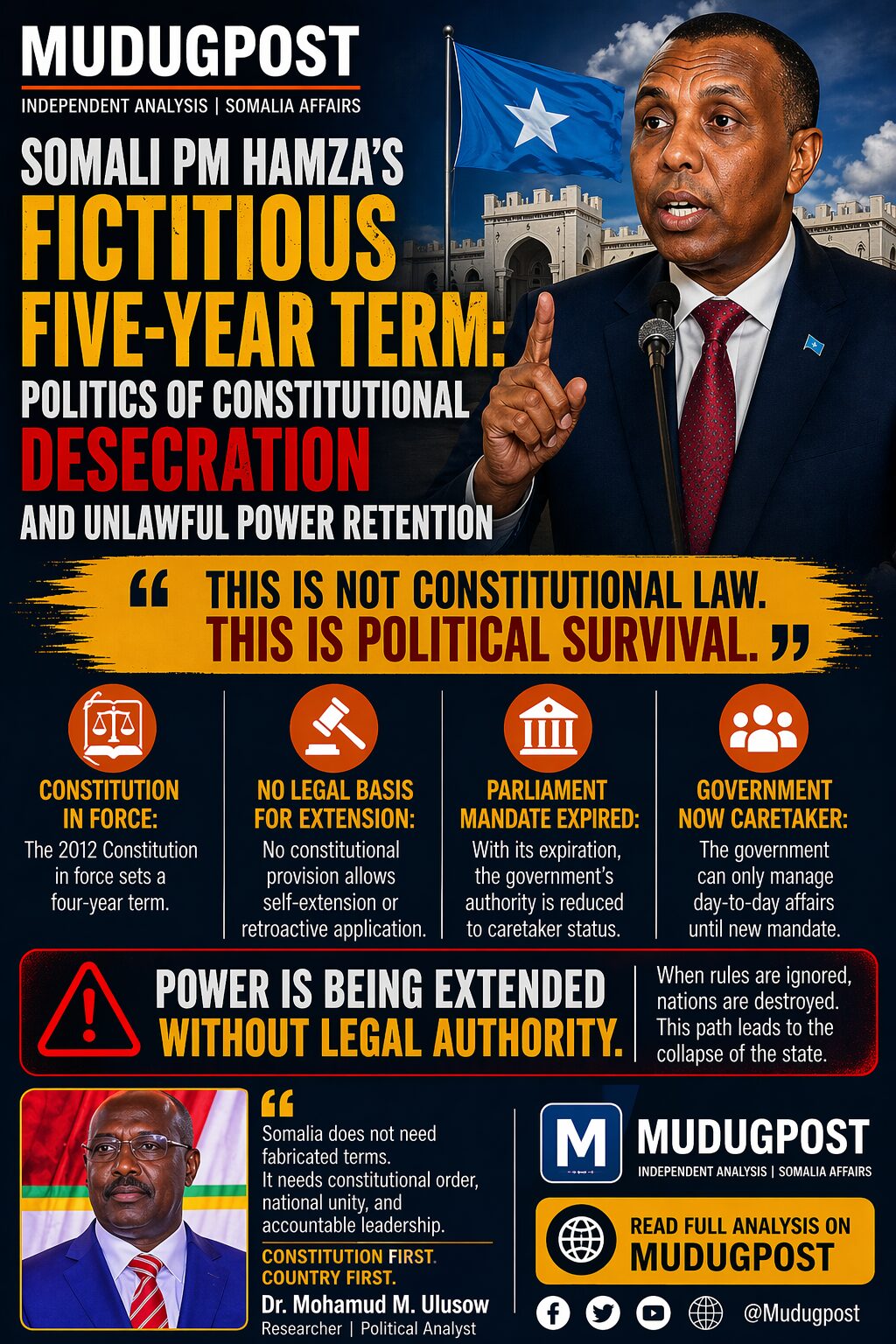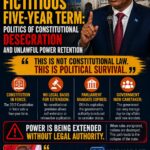



Somali PM Hamza’s Fictitious Five-Year Term: Politics of Constitutional Desecration and Unlawful Power Retention
Leaders of the Federal Government of Somalia have perfected a dangerous craft: inventing constitutional fictions to cling to power. Somali politics is no longer merely in crisis—it has entered a phase of deliberate constitutional desecration.
Caretaker Prime Minister Hamza Abdi Barre, in an official speech, advanced a line of reasoning on power retention so contradictory that it collapses under its own weight. On one hand, he invokes a five-year term he claims was provided in a 2012 constitutional text adopted by the National Constituent Assembly—while dismissing the four-year term enshrined in the official Constitution in force since August 1, 2012, and recognized internationally, including by the United Nations, the Arab League, and the African Union. In doing so, he disregards a basic legal reality: the Constitution in force is the sole foundation of Somalia’s domestic authority and international legitimacy.
On the other hand, he advances a second justification: a so-called “completed” constitution—pushed through without consensus—to claim the same five-year term. In effect, he declares, without legal basis, that the current government has an additional year and intends to remain in power until 2027 and possibly beyond. This is not constitutional interpretation; it is a calculated attempt at political survival without constitutional foundation or public consent.
The fact that this “completed” constitution has not even been officially made public only deepens doubts about its legitimacy. No constitutional framework can be applied retroactively to justify an extension of power.
The Prime Minister cannot rely on both claims. Yet he does.
From these mutually incompatible arguments, a single objective is unmistakable: to extend the political life of the current leadership—either by reviving a provision that has never governed practice or by invoking a contested, unseen document that lacks both public consensus and legal standing.
This is not a legal argument. It is political improvisation dressed as law.
The reality is clear. The mandate of the Federal Parliament has expired. With its expiration, the authority of the Federal Government is reduced to a caretaker function. There is no constitutional pathway that permits self-extension through selective interpretation or unilateral revision of the Constitution.
To suggest otherwise is to manufacture legality where none exists. It is not only unlawful—it is a deliberate abuse of constitutional order.
More troubling still is the tone. The Prime Minister appeared almost amused while advancing claims that strike at the heart of constitutional order and public trust. This is not a lapse in judgment—it signals disregard for the gravity of the moment and for the plight of the Somali public.
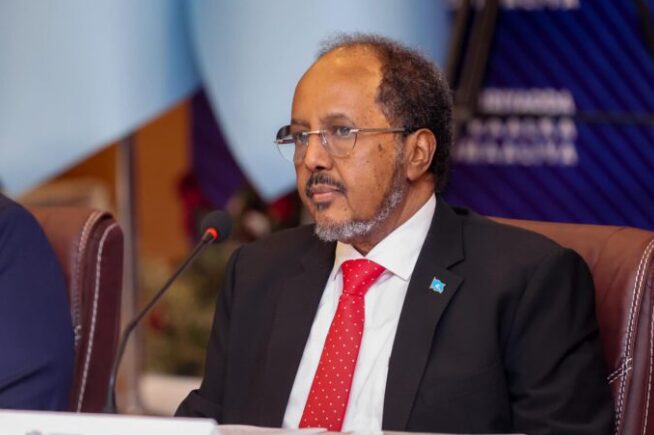
What emerges is unmistakable: President Hassan Sheikh Mohamud and his compliant Prime Minister are no longer constrained by constitutional limits. Instead, they are testing how far those limits can be bent—or ignored—without consequence.
This is how nations are extinguished.
When those in power begin to redefine rules to suit their tenure—or ignore them altogether—governance shifts from law and shared ownership to expediency and personalization. The state ceases to function as a public institution and becomes an instrument of control, sustained through coercion, inducement, and political maneuvering.
For those who still expect good-faith engagement, the signal is clear: a meaningful political process cannot exist where the rules are abandoned or rewritten midstream. What is presented as dialogue is, in reality, a tactic to prolong power rather than resolve a genuine crisis.
Somalia is being driven by actors for whom power, money, and deception outweigh principle, integrity, and public service. They act as though immune to the destructive consequences of dismantling constitutional order, eroding national unity, and undermining security and governance.
If this fabrication is allowed to stand, it will not merely extend a term—it will normalize rule by manipulation and remove the last restraints on power.
Once power escapes the limits of law, it does not return voluntarily—history shows it must be confronted or it consumes the state entirely.
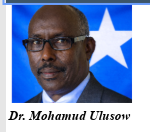
Dr. Mohamud M. Uluso